

What is Two Colour Injection Moulding Machine
Two-color injection molding machine, as the name implies, is an injection molding machine that can produce two colors of plastic products. The two-color injection molding machine injects two different colors of raw materials into the two-color mold to produce two-color plastic products with certain shapes and even patterns. Many kinds of two-color plastic products used in our daily life today are made by two-color injection molding machine, such as a toothbrush, a toy, a keyboard, etc.
Benefits of Two Colour Injection Moulding Machine
Dual-Color and Material Flexibility
The two-color injection molding machine is designed to handle a variety of thermoplastics, allowing for the simultaneous injection of two different colors or materials. This feature is perfect for creating components with unique visual effects, functional features, or enhanced aesthetics.
High Precision and Consistency
Equipped with advanced control systems, our machine ensures high precision in color separation and material distribution, providing consistent quality and reducing the risk of defects. This level of control makes it ideal for applications where accuracy is critical.
Cost-Effective Production
By combining two processes into one, the two-color injection molding machine eliminates the need for additional production steps, significantly reducing labor and production costs. The efficient cycle times also contribute to higher throughput, making it a cost-effective solution for large-scale production.
Enhanced Product Design
The ability to mold two colors or materials in one shot opens up new possibilities for innovative product designs. Whether it's a handle with a soft grip, a component with integrated functionality, or a part with a distinct color pattern, this machine makes it all possible.
User-Friendly Operation
Our two-color injection molding machine is designed with user convenience in mind. Featuring an intuitive interface and easy-to-program settings, it allows operators to quickly adjust parameters and switch between production runs, minimizing downtime and maximizing productivity.
Robust and Durable Construction
Built with high-quality materials and components, our machine offers exceptional durability and reliability, ensuring long-term performance even in demanding production environments. This robust construction minimizes maintenance needs and enhances operational uptime.

Rotary Injection Molding Machine
Double-position(or triple-position)rotating table, smooth rotation, accurate positioning, can improve the production efficiency up to 30%-50%.

Two Colour Rotary Injection Moulding Machine
Different combinations of injection units can be selected according to the injection weight requirement of the product to improve production efficiency and reduce energy loss.
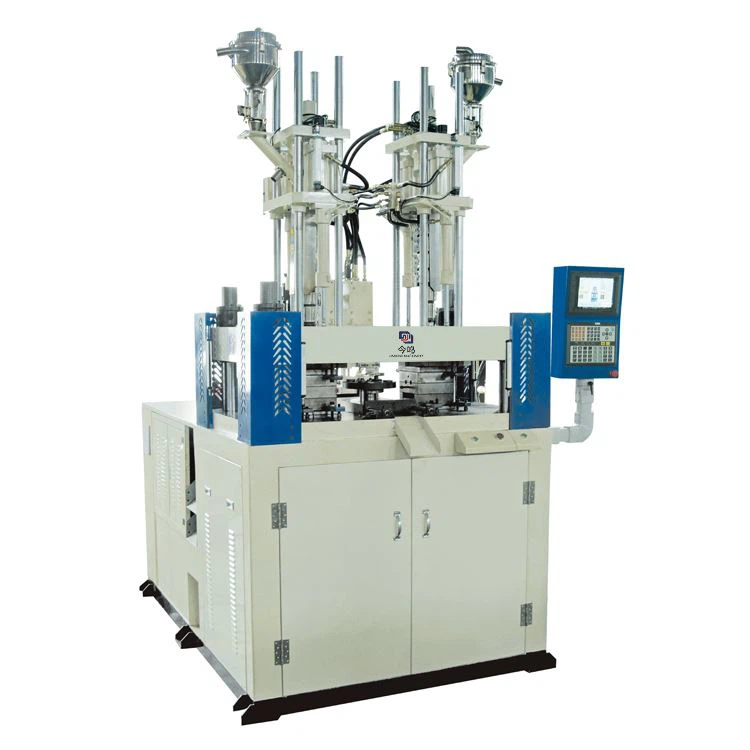
Dual Color Injection Molding Machine
Each pair of molds in the injection station has a special clamping cylinder to provide clamping force. Adhering to the characteristics of straight press, it prolongs the service life of the molds.

Single Slide Injection Molding Machine
Vertical mold clamping, vertical injection mechanism design, suitable for molding plastic products with inlaid parts

Double Slide Injection Molding Machine
Multi-segment pressure and speed control for injection and mold clamping, which can be set according to the requirement of the product, easy to adjust and ensure the precision of the product.

Right Angle Slide Injection Molding Machine
Mold locking area without machine column is fully open on three sides, which is more convenient for picking and placing inlaid parts and finished products.

Double hydraulic cylinders are balanced at both ends to push the material smoothly. The feeding port is very large, which is convenient for workers to feed, reflecting the humanized design

Servo Energy Saving Injection Molding Machine
Highly optimized clamping structure, through the further optimization of the overall structure, hydraulic system and control system, to improve the repeatability of the clamping accuracy

Liquid Silicone Injection Molding Machine
Double sliding plate or disk design, easy to pick up and put down the parts, improve the safety and increase the productivity by 30%-50% at the same time.
Why Choose Us
Advanced equipment
We take strong measures to ensure that we use the highest quality equipment in the industry and that our equipment is regularly and meticulously maintained.
Competitive prices
We offer our products at competitive prices, making them affordable for our customers. We believe that high-quality products should not come at a premium, and we strive to make our products accessible to all.
Rich experience
Has a long-standing reputation in the industry, which makes it stand out from its competitors. With over many years of experience, they have developed the skills necessary to meet their clients' needs.
High quality products
We always put customer needs and expectations in the first place, refine on, continuous improvement, to seek every opportunity to do better, to provide customers with their expectations of quality products, to provide customers with the most satisfactory service at anytime.
State-of-the-art technology
We use the latest technology and tools to deliver high quality services. Our team is well-versed in the and advancements in technology and uses them to provide the best results.
Customer satisfaction
Providing after-sales services can enhance customer satisfaction by ensuring that customers' needs are met even after the purchase. This can lead to increased customer loyalty and positive word-of-mouth referrals.
Four Types of Injection Molding Machines
In this process, the plastic granules or pellets are poured into a hopper and feed into the chamber of the heating cylinder. A plunger then compresses the material, forcing it through progressively hotter zones of the heating cylinder, where it is spread thin by a torpedo. The torpedo is installed in the center of the cylinder in order to accelerate the heating of the center of the plastic mass. The torpedo may also be heated so that the plastic is heated from the inside as well as from the outside.
The material flows from the heating cylinder through a nozzle into the mold. The nozzle seals the cylinder and the mold, and prevents leaking of molten material. The mold is held shut by the clamp end of the machine. For polystyrene, two of three tons of pressure is generally used for each inch of projected area of the workpiece and runner system.
This machine employs a torpedo ram heater to preplastify the plastic granules. After the melt stage, the fluid plastic is pushed into a holding chamber until it is ready to be forced into the mold. This type of machine produces workpiece faster than a conventional machine, because the molding chamber is filled to shot capacity during the cooling time of the workpiece. Due to the fact that the injection plunger is acting on fluid material, no pressure loss is encountered in compacting the granules. This allow for larger workpiece with more projected area.
It is an extruder used for plasticizing the plastic material. The turning screw feeds the pellets forward to the heated interior surface of the extruder barrel. The molten, plasticized material moves from the extruder into a holding chamber, and from there is forced into the mold or die by the injection plunger. The use of a screw gives the following advantages: better mixing and shear action of the plastic melt, a broader range of stiffer flow heat sensitive material can be run, color changes can be handled in a shorter time and fewer stresses are obtained in the molded part.
Reciprocating-screw injection molding machine employs a horizontal extruder in place of the heating chamber. The plastic material is moved forward through the extruder barrel by the rotation of a screw. As the material progresses through the heated barrel with the screw, it is changing from the granular to the plastic molten. As the material moves forward, the screw backs up to a limit switch that determines the volume of material in the front of the extruder barrel. During shot, the screw moves forward tp displace the material in the barrel. In this machine, the screw performs as a a ram or plunger.
Design Features of Two-Color Injection Molding Machine
Two-color molding machines are becoming more and more popular in the market, but it puts forward higher requirements for mold design, mold manufacturing and injection molding.
Molding
Two-color mold molding is almost the same as other ordinary injection molding. The difference is that the convex/core side of the injection mold at the two positions should be regarded as the same, and the concave/cavity side should fit well with the convex/core side. Such molded parts are small.
Demoulding
Since the two-color molded part can only be demolded after the second injection, the demolding system will be invalid during the first injection. For parallel turntable injection machines, the ejector system in the injection machine can be used for parts release.

Gate system
Because it is two-color molding, there are a first gate system and a second gate system from two different injection devices.
Mold
Because the two-color molding method is special and needs to be coordinated with each other, the size and accuracy of the guide devices of the two molds must be consistent. The clamping height of the parallel turntable injection machine must be the same, and the centers of the two molds should be on the same radius of rotation, with a difference of only 180°. For vertical turntable injection molding machines, the two molds should be on the same axis.
Two-colour injection moulding technology is widely used in several industries, such as the following fields which are common to our industrial life.
Automotive industry
In the automotive industry, two-colour injection moulding machines are used to produce interior trim parts such as steering wheels, instrument panels, door panels and other interior trim parts. These parts often require a combination of different colours or materials to meet aesthetic and functional requirements.
Home appliance industry
Two-colour injection moulding machines are widely used in the production of home appliances, such as TV remote controls, telephone cases, rice cooker buttons and so on. In addition, it can also produce TV sets, washing machine panels, refrigerator door handles and other household appliances.
Toys and daily necessities
Two-colour injection moulding machines are also used in the production of a variety of toys and daily necessities, such as children' s toys, thermos cup handles and so on. These products usually require a good hand feel and durability.
Electronics industry
Two-colour injection moulding machines are also heavily used in the production of electronic products, such as computer keyboards, mice and mobile phone cases. These products often require precise colour matching and high-quality surface finishes.
Medical products
In the medical field, two-colour injection moulding technology is used to produce high-precision and high-performance medical devices, such as syringe casings and handles for surgical tools.
The 2 shapes of the female mold must be different, making a product separately, while the 2 shapes of the male mold must be actually the same.
After the center of the mold is rotated 180 degrees, the mold must be steady. The water of the 3 plate mold can be designed with mechanical demoulding. The full thickness of the front panel plus A board should not be less than 170mm. The highest thickness of the mold, the lowest thickness of the mold and the distance of the Ko hole should be rightly studied.
When the designing the master mold for 2 shot injection, in order to reject the second master mold from scratching the glue area of the first mold item, a part of it can be designed to reject voids. Anyway, it is necessary to rightly consider the strength of each sealing part.
Injection molding, the item size of the first injection molding can be pretty bigger, so that it can be tighter with others in the second molding to meet the sealing effect. Pay focus to the second injection, the plastic flow will impact the primary molded item and deform the glue. Before closing the mold B board or A board, pay focus to whether the front mold slider or inclined top will reset and crush the item first.
The water distribution of the 2 female molds and male mold should be used as much as easy and balanced. In 99 percent of cases, the hard rubber part of the product is injected first, and then soft rubber part of the injection item, because the soft rubber is simply deformed.
Injection Molding Machine Components & It's Function
Hopper
This is the part at the top of the machine. It is a funnel-shaped container where the plastic material is fed into the machine. The hopper helps in feeding the material into the barrel.
Barrel
The barrel is a hollow pipe-like part with a heating element. It is where the plastic injection hardware mould material is melted and mixed. The barrel has a reciprocating screw which helps in transporting the molten plastics into the mold.
Heaters
Heaters are used to melt the plastic material in the barrel. Usually, band heaters are used which wrap around the barrel. Temperature sensors are also used to monitor the temperature.
Screw
The screw sits inside the barrel and rotates and moves forward and backward. It helps in transporting the molten plastics into the mould by its reciprocating action. The screw also mixes and blends the molten plastics.
Clamping Unit
It is the part that attaches to the mold and opens and closes the mold. The clamping unit applies the necessary clamping force so that the mold halves can be securely closed during injection and molding.
Injection Unit
The injection unit injects the molten plastics into the mold through a sprue. It consists of a nozzle at the end which injects the plastics into the mold at high pressure.
Mould
The mold consists of two halves - cavity and core. The molten plastics solidify inside the mold and take the shape of the mold's inner surface. The mold opens once the part has solidified.
Ejector assembly
Once the mold opens, the ejector assembly helps in ejecting the molded part out of the mold. It pushes the part out of the mold using ejector pins.
Controllers
Controllers help in controlling, adjusting, and monitoring the various parameters of the injection molding machine including temperature, pressure, screw positions, etc.
The Technical Parameter of Double Color Injection Molding Machine
|
Technical Parameter |
Unit |
ZH-300T-SS |
||
|
Injection 1 |
Injection 2 |
|||
|
Injection Unit |
Screw Diameter |
mm |
31 |
36 |
|
Theoretical Injection Volume |
g |
94 |
152 |
|
|
Injection Pressure |
Mpa |
220 |
180 |
|
|
Injection Speed |
mm/s |
120 |
||
|
Screw Speed |
rpm |
10-300 |
||
|
Clamping Unit |
Clamping Force |
KN |
3000 |
|
|
Mode-shifting Trip |
mm |
470 |
||
|
Space Between Ti-bars |
mm |
957*570 |
||
|
Diameter of Rotary Table |
mm |
∅1086 |
||
|
Rotary Table Load-bearing |
KG |
1200 |
||
|
Max.Mould Height |
mm |
520 |
||
|
Min.Mold Thickness |
mm |
230 |
||
|
Ejection Stroke |
mm |
100 |
||
|
Ejector Force |
KN |
33*2 |
||
|
Thimble Root Number |
pcs |
5*2 |
||
|
Mold Center Distance |
mm |
550 |
||
|
Clamping Type |
|
Toggle Clamping |
||
|
Others |
Maximum Oil Pump Pressure |
Mpa |
16 |
|
|
Pump Motor Power |
KW |
18 |
22 |
|
|
Electrothermal Power |
KW |
6.5 |
6.5 |
|
|
Hopper Volume |
KG |
50 |
50 |
|
|
Tank Capacity |
L |
350 |
||
|
Machine Dimensions (L*W*H) |
M |
4.6*1.8*2.2 |
||
|
Machine Weight |
T |
12.2 |
||
How Do I Ensure Safety During the Operation of an Injection Molding Machine
Injection molding machine operating procedures are as follows:
1. The operator must be familiar with and understand the functions of each switch button on the equipment operation panel, and Strictly follow the operating procedures and precautions.
2. Before heating the machine and starting production, open the cooling water valve and observe whether the water channel is smooth.
3. Close the power switch on the side of the control box, turn on the power inside the machine, and press the motor on the panel to start.
Press the button to start the oil pump motor.
4. For machines that are used for the first time or have not been used for a long time, after the oil pump is started, several operations must be performed first. After a few minutes of empty operation, the operation can be started.
5. Turn on the heating switch of the material sheet, turn on the electric heating power supply, and adjust the thermostatic nozzle and temperature control on the box door. Make the instrument, set the temperature, and observe the current of the ammeter to determine the quality of the electric heating coil. Good or bad.
6. The test run should be carried out sequentially from manual → semi-automatic → fully automatic, and important fastenings should be checked at the same time. Check whether the bolts are loose and stop immediately if any abnormalities are found. When confirming normality or troubleshooting Finally, conduct a test run.
7. The barrel must be cleaned when processing is stopped or materials are changed. The cleaning work should be done while the barrel is heating. When cleaning is completed, turn off the heating switch immediately. The cleaning work is easy to separate for processing. Solving plastics is particularly important.
Yuyao Jinming Machinery Co., Ltd. was established in 2010, with products for a wide range of markets. The company focuses on the vertical injection molding machine, rubber injection machine and Bakelite, BMC and other high-precision injection molding equipment research and development and production, the introduction of advanced technology in Europe, Japan, quality is the key to business survival as the concept of enterprise development, continuous improvement and innovation, manufacturing a series of high-quality, high-precision vertical injection molding machine, the company's products are sold all over the world, excellent quality and perfect after-sales service by the Our products are sold all over the world, and our excellent quality and perfect after-sales service are well received by customers all over the world.
FAQ
Hot Tags: two colour injection moulding machine, China two colour injection moulding machine manufacturers, suppliers, factory, ceramic injection molding machine, semi automatic injection moulding machine price, benchtop injection molding machine for sale, 2500 ton injection molding machine, usb cable moulding machine, Semi Automatic Injection Moulding Machine
| DESCRIPTION | UNIT | JM-550.2C | JM-850.2C | |||
| INJECTION UNIT | Screw Diameter | mm | A28 | B28 | A32 | B32 |
| Injection Pressure | kg/cm² | 1446 | 1446 | 1531 | 1531 | |
| Theoretical Injection Volume | cm³ | 68 | 68 | 113 | 113 | |
| Max. Shot Weight(PS) | g/oz | 66/2.4 | 66/2.4 | 110/4 | 110/4 | |
| Injection Rate | cm³/sec | 53 | 53 | 59 | 59 | |
| Screw Stroke | mm | 110 | 110 | 140 | 140 | |
| Screw Rotation Speed | rpm | 0-200 | 0-200 | 0-200 | 0-200 | |
| Center Distance Of Nozzle | mm | 150 | 200 | |||
| CLAMPING UNIT | Clamping Force | ton | 55 | 85 | ||
| Min. Mold Height | mm | 220 | 250 | |||
| Opening Stroke | mm | 200 | 250 | |||
| Max. Opening Distance | mm | 420 | 500 | |||
| Distance Between Tie Bar | mm | 500x340 | 560x340 | |||
| Platen Size | mm | 720x560 | 795x575 | |||
| Ejector Stroke | mm | 45 | 55 | |||
| Ejector Force | ton | 2.3 | 4 | |||
| OTHERS | Max. Hydraulic Pressure | kg/cm² | 140 | 140 | ||
| Oil Tank Capacity | L | 230 | 280 | |||
| Pump Motor Power | kW | 7.5 | 11 | |||
| Barrel Heating Power | kW | 5.4 | 5.4 | |||
| Machine Weight | kg | 2700 | 3500 | |||
| Machine Dimensions | m | / | / | |||


