

What is All Electric Injection Molding Machine
An all-electric injection molding machine is a process injection molding machine where all power is supplied by electricity. All electric injection molding machines do not have a central motor, but use individual motors designed for each function required by the entire machine, i.e. mold opening/closing, injection, recovery and ejection. This means that the motor can be left idle until its specific function is required. It is currently gaining popularity in the market and is highly preferred mainly because it offers performance that cannot be achieved by a fully hydraulic injection molding machine.
Benefits of All Electric Injection Molding Machine
Stable injection
The all-electric injection molding machine is less affected by external factors, its mold molding parameters are controlled by a computer, and the injection performance is stable; while the dynamic technical parameters of the all-hydraulic injection molding machine are susceptible to fluctuations due to changes in hydraulic oil temperature.
Energy saving and cost reduction
Each movement of the all-electric injection molding machine is controlled by its corresponding motor without driving other control motors, and each actuator is directly driven by electricity, its production efficiency and energy utilization rate are high, and the energy saving effect is significant. In addition, the all-electric injection molding machine does not need to use hydraulic oil, thus eliminating the need to cool the working oil, reducing the use of cooling water, and reducing production costs.
Efficient control
The application of the servo motor of the all-electric injection molding machine improves the responsiveness of the system, so its response is sensitive, the action speed is fast, and the action accuracy is high. Each part of the action is controlled by an independent motor, so the injection molding machine can perform compound actions, and multiple processes can be performed at the same time, which greatly improves production efficiency.
High precision
With the advantages of high speed, high efficiency and high precision, the all-electric injection molding machine is more suitable for processing high value-added products such as electronics, electrical appliances, high-cleanliness medical products, etc., especially for the injection molding of small parts. Its advantages of high performance and high precision injection molding.
Environmental optimization
The all-electric injection molding machine has low noise during operation, and no working oil is used in the operation of the machine, so there will be no mechanical oil leakage and other problems to keep the environment clean.

Single Slide Injection Molding Machine
Vertical mold clamping, vertical injection mechanism design, suitable for molding plastic products with inlaid parts

Double Slide Injection Molding Machine
Multi-segment pressure and speed control for injection and mold clamping, which can be set according to the requirement of the product, easy to adjust and ensure the precision of the product.

Right Angle Slide Injection Molding Machine
Mold locking area without machine column is fully open on three sides, which is more convenient for picking and placing inlaid parts and finished products.

Rotary Injection Molding Machine
Double-position(or triple-position)rotating table, smooth rotation, accurate positioning, can improve the production efficiency up to 30%-50%.

Two Colour Rotary Injection Moulding Machine
Different combinations of injection units can be selected according to the injection weight requirement of the product to improve production efficiency and reduce energy loss.
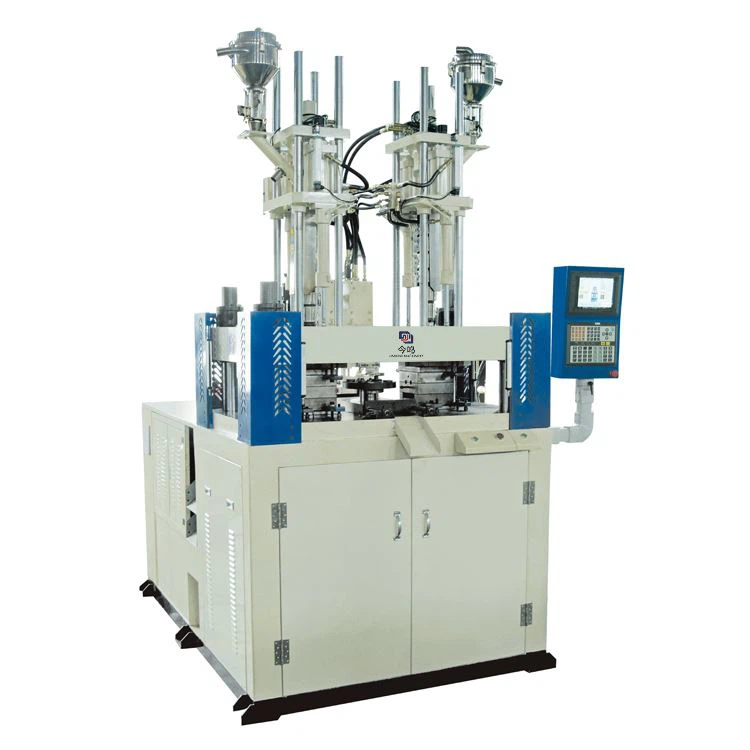
Dual Color Injection Molding Machine
Each pair of molds in the injection station has a special clamping cylinder to provide clamping force. Adhering to the characteristics of straight press, it prolongs the service life of the molds.

Bakelite Injection Molding Machine
Adopting high-performance control system, with mold injection process parameter memory function and fault diagnosis alarm function.

Double hydraulic cylinders are balanced at both ends to push the material smoothly. The feeding port is very large, which is convenient for workers to feed, reflecting the humanized design

Servo Energy Saving Injection Molding Machine
Highly optimized clamping structure, through the further optimization of the overall structure, hydraulic system and control system, to improve the repeatability of the clamping accuracy
Why Choose Us
Advanced equipment
We take strong measures to ensure that we use the highest quality equipment in the industry and that our equipment is regularly and meticulously maintained.
Competitive prices
We offer our products at competitive prices, making them affordable for our customers. We believe that high-quality products should not come at a premium, and we strive to make our products accessible to all.
Rich experience
Has a long-standing reputation in the industry, which makes it stand out from its competitors. With over many years of experience, they have developed the skills necessary to meet their clients' needs.
High quality products
We always put customer needs and expectations in the first place, refine on, continuous improvement, to seek every opportunity to do better, to provide customers with their expectations of quality products, to provide customers with the most satisfactory service at anytime.
State-of-the-art technology
We use the latest technology and tools to deliver high quality services. Our team is well-versed in the and advancements in technology and uses them to provide the best results.
Customer satisfaction
Providing after-sales services can enhance customer satisfaction by ensuring that customers' needs are met even after the purchase. This can lead to increased customer loyalty and positive word-of-mouth referrals.

Electric injection molding machines consume energy only when a given action is required and match the motor output to meet the requirements, unlike conventional hydraulic injection molding machines that consume energy continuously even when idle.
Instead of being driven by a hydraulic system, electric injection molding machines are digitally controlled by high speed and efficient servo motors to drive the entire process. Each axis is controlled by an independent motor for injection, extrusion, clamping and ejection.
The result is an injection molding process that is faster, cleaner, more repeatable and more energy efficient. Electric injection molding machines can reduce energy consumption by 50 to 75 percent compared to hydraulic models.
Due to the recent increase in electricity costs in the industry, all electric injection molding machines are becoming more popular to save money on electricity, which ultimately leads to lower overall operating costs.
All-Electric Injection Molding Machines Applications
Medical and Pharmaceutical Industry
Due to their clean operation and high precision, all-electric machines are ideal for manufacturing medical devices and pharmaceutical packaging.
Electronics
The high precision and fast cycle times of all-electric machines make them perfect for producing small, detailed electronic components with tight tolerances.
Automotive
In automotive applications, where consistent quality and material performance are critical, all-electric machines are used for producing precision parts such as connectors and interior components.
Consumer Goods
High efficiency and low operation costs make these machines suitable for the mass production of consumer products, from packaging to household items.
What are the Types of Injection Molding Machines
Injection molding machine types are frequently classified based on their drive systems. different types of injection molding machines can be chosen for various application areas.
Hydraulic drives are used to secure the halves of the injection mold and to inject molten plastic into the mold cavity. These drives require hydraulic fluid and continuous energy for operating and cooling their hydraulic systems.
Despite its affordability, it is capable of meeting high precision requirements and can generate substantial clamping force. Hydraulic injection molding machines are typically used for creating larger, thick-walled products, like those in the automotive industry.
Yet, its reliance on hydraulic power requires frequent use and upkeep. If not operated regularly, the hydraulic injection molding machine may stop working.
The all-electric injection molding machine utilizes electrical servo motors to inject, extrude, clamp, and eject parts in the production.
Although it has a lower clamping force and is more expensive compared to its hydraulic counterpart, the all-electric machine excels in producing plastic parts with high precision (up to 0.01mm), cleanliness, and low noise levels. These attributes make the all-electric injection molding machine particularly well-suited for the manufacture of medical products in cleanroom environments.
Hybrid injection molding machines blend the best features of hydraulic and electric machines.They use servo motor pumps for the hydraulic fluid, which helps control power, emissions, noise, and energy use, and electrical power.
The cost of hybrid models fluctuates depending on size and application, but typically falls between the prices of electric and hydraulic injection molding machines.
Equipped with servo motors, these machines match the cost savings of all-electric models while enhancing user-friendliness and precision in clamping mechanisms, thereby reducing maintenance costs. However, it challenges technicians requiring both knowledge of electric and hydraulic operation systems.
What Is the Development Trend of All-Electric Injection Molding Machine Technology
With the emergence of new synthetic materials, the use of high-precision injection molded parts and energy saving Environmental awareness is increasing, and the demand for injection molding machines is further enhanced. Among the various new precision injection molding machines, the most representative one is the all-electric precision injection molding machine.
The crank slider mechanism is the same. The maximum ejector stroke is twice the diameter of the crank revolution, and the ejection force and speed are varied during the ejection process. When the ball screw ejector mechanism is used, the ejector speed can be adjusted by adjusting the motor speed.
The ejector mechanism has a simple structure and a stable ejector. In addition, the nozzle movement action can be driven by the motor and the ball screw mechanism.
For example, the precision of electronic components, digital cameras, mobile phone casings and optical components is not only highly demanding on materials, but also imposes high requirements on molding technology.
The servo electric injection molding machine has unique advantages in solving such problems, and has two remarkable features of reducing environmental load and high performance. It not only saves energy (power consumption is about 1/3 of that of a typical hydraulic press), low noise, saves water (water consumption is about 1/12 of that of a typical hydraulic press), and power supply equipment shows great advantages, and has performance in terms of performance. High injection rate, high response, stable injection speed, stable back pressure system,
The ejector device of the all-electric injection molding machine may be a crank slider mechanism or a ball screw mechanism. When using the crank slider mechanism, one end of the slider is connected with the connecting rod, and the other end is connected with the ejector rod or the ejector plate. The movement and dynamic characteristics of the slider are the characteristics of the ejector device, and the design method and the injection device
Since the motor speed can be precisely adjusted, the moving speed of the injection seat can also be adjusted as needed during the movement.
When the nozzle is in contact with the mold, there is no impact, which is beneficial to the protection of the mold, and at the same time, the contact force of the nozzle can be controlled.
Injection Molding Machine Parts
Injection Unit
This is where the magic begins. The injection unit .is like a chef in the kitchen, responsible for melting and injecting the plastic material into the mold tocook up your desired product.
Clamping Unit
Imagine holding a mold in place while the injection unit does its thing. That's the job of the clamping unit. It's the sturdy hands that keep everything incheck during the plastic party.
Hydraulic System
Think of this as the power bank. All the tasks that are performed in the injection machine are done by the hydraulic systems as it provides theenergy. These tasks include clamping, ejecting, and injecting.
Control Panel
Meet the brain of the operation. The control panel is where the settings are dialed in- -temperature, pressure, time- -it's all controlled here, makingsure everything is just right.
Drive System
This is the muscle behind the movement. The drive gystem powers the parts that need to move, like the injection screw, the mold's open-and-close dance,and the ejection process.
Mold System
If the injection unit is the chef, the mold system is the mold itself. It shapes and defines the plastic, determining the final look and feel of the product.
Ejector Unit
Picture a gentle push to release a finished product. The ejector unit is responsible for ensuring the molded product smoothly exits the mold.
How to Maintain Your Injection Molding Machine
Follow the Manufacturer's Recommendations
Your injection molding machine's manufacturer will have recommendations for maintenance and service. It's essential to follow these recommendations to ensure your machine operates optimally. This may include regular lubrication, filter changes, and inspections. Don't worry, Min-Hui will tell you the corresponding notes.
Keep the Machine Clean
Keeping your injection molding machine clean is vital to prevent contamination and maintain the quality of your products. Regular cleaning will prevent debris from building up, which can cause damage or wear on your equipment. Wipe down the machine's exterior daily and use a vacuum to clean the interior regularly.
Check for Leaks
Leaks can cause significant issues for your injection molding machine. Regularly inspect the machine for any leaks in hoses, fittings, and seals. If you find any leaks, address them immediately to prevent any further damage.
Monitor the Machine's Oil Levels
The oil in your injection molding machine is essential for keeping it lubricated and running efficiently. Regularly check the oil levels and change the oil as recommended by the manufacturer. Failing to change the oil can cause significant damage to your equipment and result in costly repairs.
Inspect the Machine's Cooling System
Your injection molding machine's cooling system is critical to maintaining a consistent temperature during the molding process. Inspect the cooling system regularly for any leaks, clogs, or damage. Keeping the cooling system in good working order will help prevent overheating, which can damage your machine and cause product defects.
Train Your Employees
Your employees play a significant role in the maintenance of your injection molding machine. Train them on the importance of regular maintenance, and provide them with the tools and resources they need to keep the machine in good working order. This includes educating them on how to identify issues and report them promptly.
Schedule Regular Maintenance
Regular maintenance is key to keeping your injection molding machine in top condition. Schedule routine maintenance with a qualified technician to ensure that your machine is running efficiently and that any potential issues are addressed before they become major problems.
Our Factory
Yuyao Jinming Machinery Co., Ltd. was established in 2010, with products for a wide range of markets. The company focuses on the vertical injection molding machine, rubber injection machine and Bakelite, BMC and other high-precision injection molding equipment research and development and production, the introduction of advanced technology in Europe, Japan, quality is the key to business survival as the concept of enterprise development, continuous improvement and innovation, manufacturing a series of high-quality, high-precision vertical injection molding machine, the company's products are sold all over the world, excellent quality and perfect after-sales service by the Our products are sold all over the world, and our excellent quality and perfect after-sales service are well received by customers all over the world.

FAQ
Hot Tags: all electric injection molding machine, China all electric injection molding machine manufacturers, suppliers, factory, Barrel Injection Molding Machine, Automatic Injection Machine, Bucket Moulding Machine, Horizontal Thin Wall Injection Molding Machine, Power Cord Moulding Machine, Thin Wall Injection Molding Machine
| Machine Model | MACHINE TYPE | UNIT | 50T | 75T | 100T | |||||||
| INJECTION SYSTEM | Screw Diameter | mm | 18 | 22 | 25 | 22 | 25 | 30 | 25 | 30 | 35 | |
| Injection Pressure | kg/cm² | 280 | 210 | 180 | 280 | 230 | 180 | 250 | 200 | 180 | ||
| Ejection Stroke | mm | 100 | 100 | 100 | 120 | 120 | 120 | 160 | 160 | 160 | ||
| Injection Speed | mm/s | 600 | 600 | 600 | 600 | 600 | 600 | 600 | 600 | 600 | ||
| Screw Rotation Speed | rpm | 0-350 | 0-350 | 0-350 | ||||||||
| Barrel Heating Power | kW | 4.2 | 5.4 | 6.3 | ||||||||
| Nozzle Stroke | mm | 195-325 | 205-360 | 240-375 | ||||||||
| CLAMPING SYSTEM | Mold Closing Method | - | Curved arm bending type | Curved arm bending type | Curved arm bending type | |||||||
| Clamping Force | KN | 500 | 750 | 1000 | ||||||||
| Opening Stroke | mm | 250 | 280 | 320 | ||||||||
| Mold Thickness | mm | 150-350 | 150-350 | 200-400 | ||||||||
| Template Spacing | mm | 600 | 630 | 720 | ||||||||
| Distance Between Tie Bar | mm | 360x360 | 420x420 | 500x500 | ||||||||
| Ejector Force | KN | 22 | 22 | 22 | ||||||||
| Ejector Stroke | mm | 50 | 60 | 75 | ||||||||
| OTHERS | Supply Voltage | - | 3-phase 380V-50Hz | 3-phase 380V-51Hz | 3-phase 380V-52Hz | |||||||
| Main Switch Capacity | KVA | / | / | / | ||||||||
| Hopper Capacity | L | 15 | 15 | 15 | ||||||||
| Machine Weight | kg | / | / | / | ||||||||
| Cooling Water Consumption | L/min | / | / | / | ||||||||
| Machine Dimensions | m | / | / | / | ||||||||


